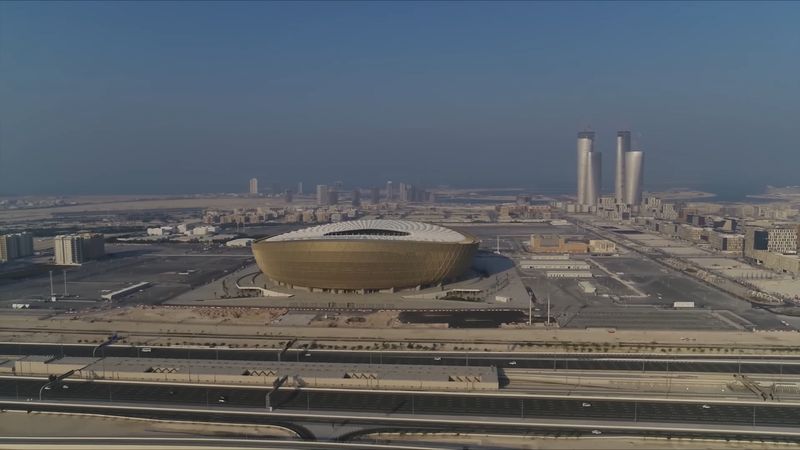
Lusail
Lusail Stadium
The golden bowl built for the 2022 final, its facade inspired by traditional Arab vessels and the play of light in fanar lanterns.
- Opened
- 2022
- 2022 seats
- c. 89,000
The 2022 venues
Seven venues in and around Doha and one up the coast in Al Khor. Compare their size, design and metro links, and find out how to see a game in one of them today.
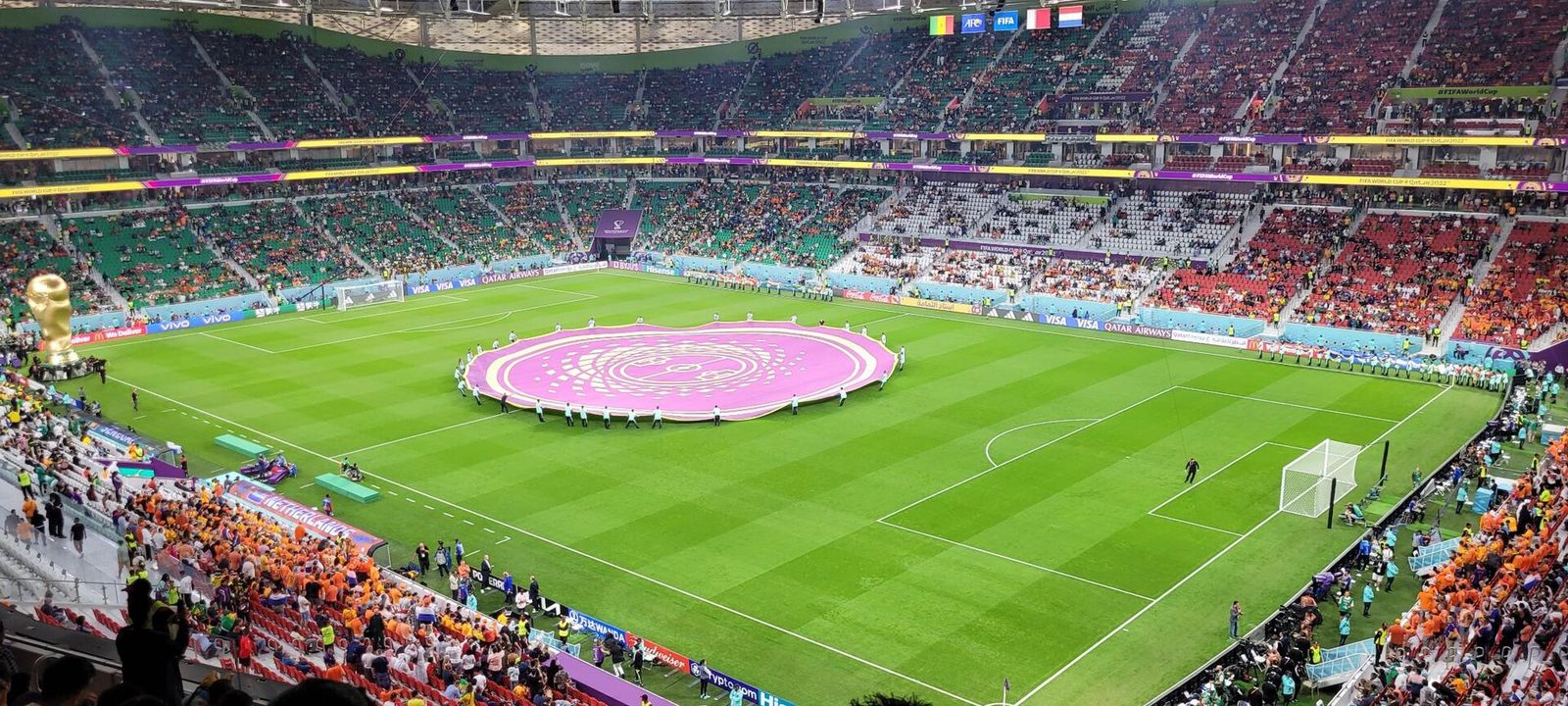
A pre-match ceremony at Al Thumama Stadium during the 2022 World Cup.
The big picture
Most World Cups ask fans to fly between host cities. Qatar's asked them to take the metro.
The eight stadiums of the 2022 tournament fit inside a circle you can drive across in about an hour. The two farthest apart, Al Bayt in the north and Al Janoub in the south, are only about 55 km apart as the crow flies. Seven are in Doha or the municipalities that run into it. Only Al Bayt, up the coast in Al Khor, calls for a proper road trip. During the group stage, those short distances made it possible to watch two matches in a single day.
Six of the eight were built from scratch for the tournament. Khalifa International Stadium, which first opened in 1976, was rebuilt and reopened in 2017. Ahmad bin Ali Stadium replaced an older ground of the same name, the home of Al Rayyan SC, which was demolished in 2015. Together they make a striking set: a golden bowl, a nomadic tent, a stack of shipping containers, a woven cap and a dhow's sail, each with its own story to tell before kick-off.
This page compares them side by side. Each stadium also has its own page, with directions, visiting tips and the matches that made its name, starting with Lusail Stadium.
Geography
From north to south, the eight fall into five clusters. If you want to see more than one in a day, pair stadiums within the same cluster or on the same metro line.
The outlier. Al Bayt's striped tent stands on the southern side of Al Khor, roughly 35 to 45 km north of the capital. There is no metro line, so plan for the road.
The planned city north of Doha holds the biggest stadium, close to the northern end of the Red Line, along with the motor-racing circuit and a large indoor arena.
Stadium 974 sits on the eastern waterfront at the end of the Gold Line. Al Thumama lies to the south, near Hamad International Airport, and is reached by the Red Line plus a feeder bus.
West of the centre, three stadiums: Khalifa International in Aspire Zone on the Gold Line, Education City Stadium on the Green Line, and Ahmad bin Ali further out on Dukhan Road, at the end of the Green Line.
The old pearling town south of Doha, at the southern end of the Red Line, is home to Al Janoub and its curving, sail-like roof.
Lusail Stadium Lusail station
Al Janoub Stadium Al Wakra station, then a walk or shuttle
Al Thumama Stadium Free Zone station, then a feeder bus
Education City Stadium and Ahmad bin Ali Stadium Education City and Al Riffa stations
Stadium 974 and Khalifa International Stadium Ras Bu Abboud and Sport City stations
Al Bayt Stadium, Al Khor No metro; on big match days organisers usually run shuttle buses
Services change on big event days. Check the metro operator's current information before you travel.
Stadium by stadium
Swipe or use the arrows to browse the stadiums in our 01 to 08 order, from Lusail Stadium to Ahmad bin Ali Stadium. Each card links to a full page with directions and visiting tips.
Lusail
The golden bowl built for the 2022 final, its facade inspired by traditional Arab vessels and the play of light in fanar lanterns.
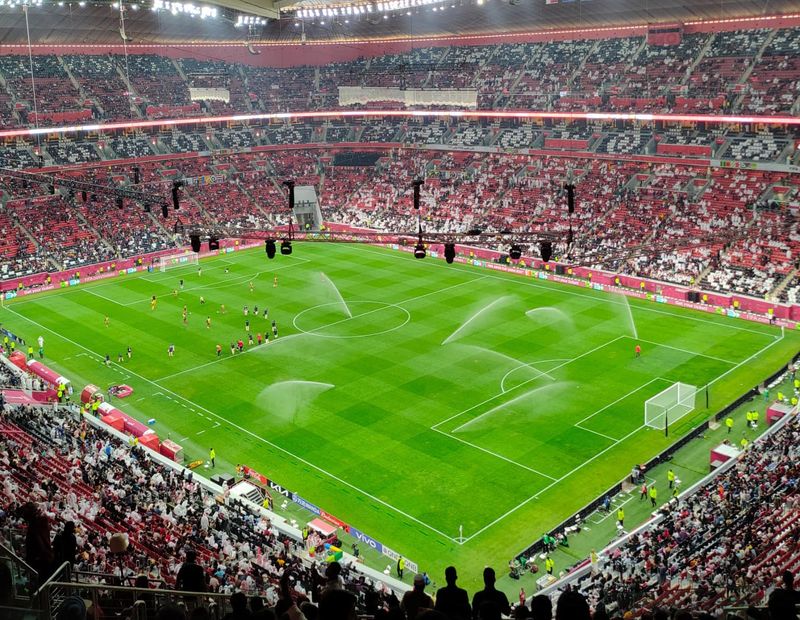
Al Khor
A vast black, white and red tent modelled on the bayt al sha'ar of the region's nomadic peoples, with a roof that can close.
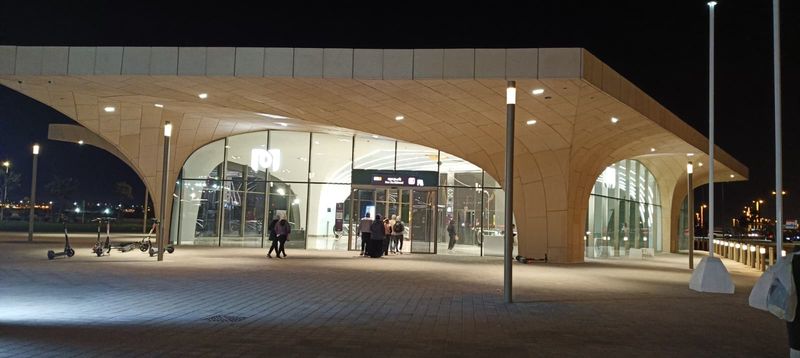
Pictured: Ras Bu Abboud metro station, the stop for the stadium
Ras Abu Aboud, Doha
A waterfront arena assembled from shipping containers; the name recalls the 974 containers used and Qatar's international dialling code.
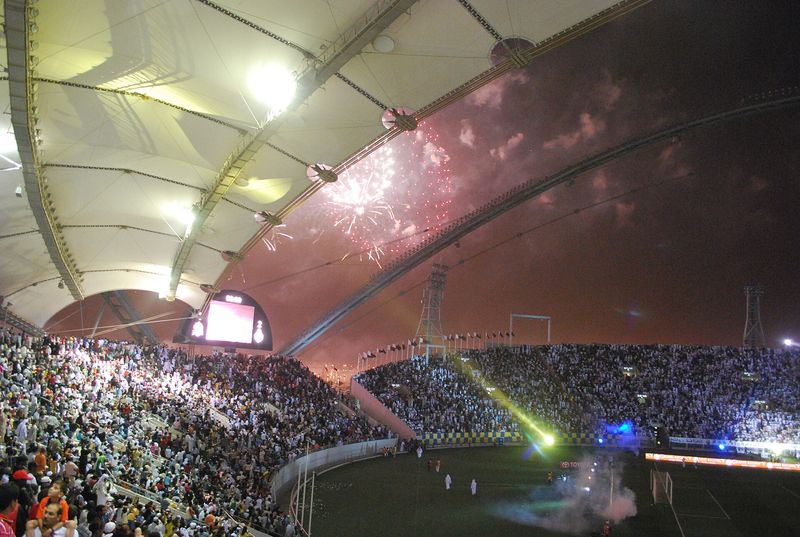
Pictured in 2009, before the rebuild
Aspire Zone, Al Rayyan
The veteran of the eight: opened in 1976, then rebuilt beneath two sweeping arches and reopened in 2017.
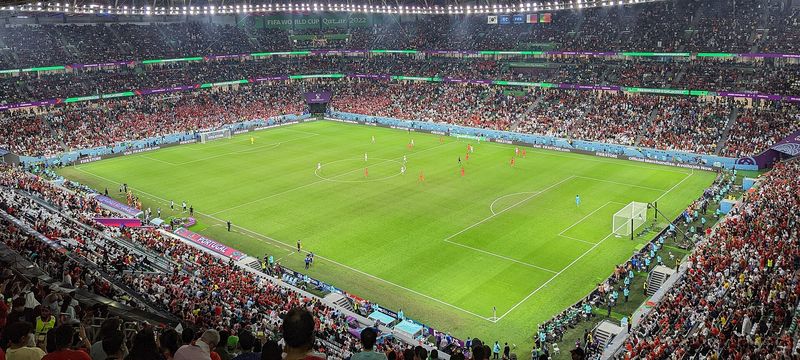
Education City, Al Rayyan
Nicknamed the Diamond in the Desert for its skin of triangular panels, which seem to change colour as the sun moves.
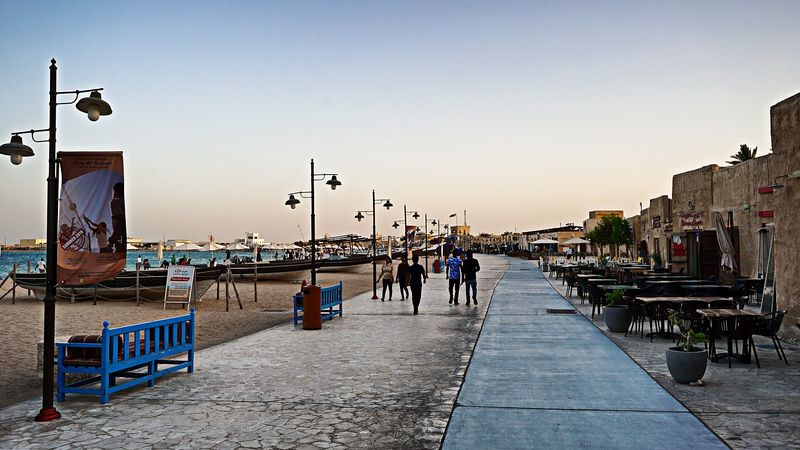
Pictured: the Al Wakrah seafront, not the stadium
Al Wakrah
Zaha Hadid Architects shaped its curving roof after the sails of the dhows once used by the town's pearl divers.
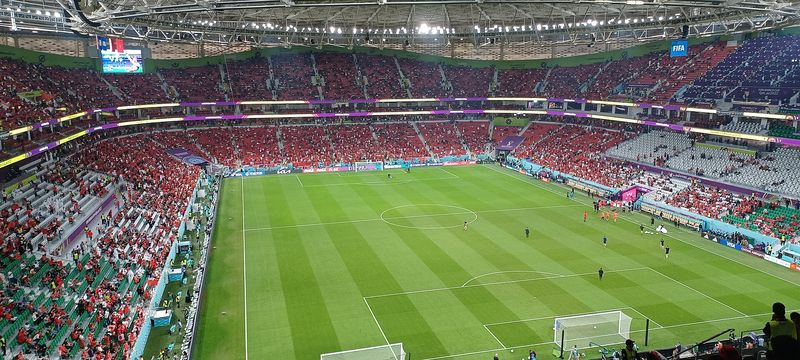
Al Thumama, Doha
A white circular form based on the gahfiya, the woven cap worn by men and boys across the Arab world.
Pictured: Qatari desert dunes, not the stadium
Al Rayyan
Home of Al Rayyan SC, rebuilt with a facade of patterns that draw on the desert, native wildlife and the country's trading past.
Side by side
Area, opening year, 2022 capacity, the idea behind each design and the nearest public transport, in one table. On a phone, swipe the table sideways.
| Stadium | Area | Opened | 2022 seats | Design inspiration | Nearest transport |
|---|---|---|---|---|---|
| Lusail Stadium | Lusail | 2022 | c. 89,000 | Fanar lanterns and decorated Arab vessels | Red Lusail |
| Al Bayt Stadium | Al Khor | 2021 | c. 68,900 | The bayt al sha'ar nomadic tent | Road No metro; shuttles on big days |
| Stadium 974 | Ras Abu Aboud, Doha | 2021 | c. 44,100 | Recycled shipping containers, built to be dismantled | Gold Ras Bu Abboud |
| Khalifa International Stadium | Aspire Zone, Al Rayyan | 1976 | c. 45,500 | Twin arches over a rebuilt bowl (reopened 2017) | Gold Sport City |
| Education City Stadium | Education City, Al Rayyan | 2020 | c. 44,700 | "Diamond in the Desert" triangular facade | Green Education City |
| Al Janoub Stadium | Al Wakrah | 2019 | c. 44,300 | The sails of pearl divers' dhows | Red Al Wakra, then a walk or shuttle |
| Al Thumama Stadium | Al Thumama, Doha | 2021 | c. 44,400 | The gahfiya, a woven cap | Red Free Zone, then a feeder bus |
| Ahmad bin Ali Stadium | Al Rayyan | 2020 | c. 45,000 | Patterns of family, desert, wildlife and trade | Green Al Riffa |
Capacities are for the 2022 tournament layout, rounded to the nearest hundred. Published figures differ slightly between sources, and several stadiums were planned to shrink after the tournament. "Opened" is the year of the first match; Khalifa International first opened in 1976 and reopened after its rebuild in 2017.
Capacity
The chart shows how the tournament was planned. Lusail was built for the final and held almost 89,000 people. Al Bayt, which staged the opening match, seated close to 69,000. The other six were all designed around a similar size of roughly 44,000 to 45,500 seats, enough for group and knockout matches without overbuilding.
Read the bars as the 2022 layout, not as today's count. Several stadiums were designed with removable upper tiers, and those reductions have moved at different speeds. Before a big game, check the current capacity and the open stands in the event information.
Climate
Seven of the eight stadiums are cooled. The eighth relies on the sea breeze.
The cooled stadiums use a system developed for the tournament by a Qatar University team led by engineer Saud Abdul-Ghani, whom the press nicknamed "Dr Cool". Instead of chilling an entire open bowl, it delivers chilled air where people are: through nozzles beside the pitch and small diffusers under the seats. Much of that air is then drawn back, filtered and cooled again. Roofs and the shape of the stands help hold the cool pocket inside. Khalifa International Stadium was the first to use it when it reopened in 2017. Quoted target temperatures vary between sources, from around 20 °C to the mid-20s.
The exception is Stadium 974, which has no mechanical cooling and played all its 2022 matches in the evening. On sustainability more broadly, the organisers pointed to solar power for the cooling, green-building ratings, reused materials and modular seating. Independent analysts challenged the tournament's carbon-neutral claim, so it is fair to treat the official figures as claims rather than settled fact.
Spot cooling
The system cools the stands and the pitch, not the plazas outside. The walk from the station is still exposed to the weather.
Sea breeze
The container stadium relies on its waterfront site and an open structure that lets the breeze pass through the stands.
Modular seating
Several stadiums have upper tiers designed to be removed after the tournament and the seats reused elsewhere.
Timing
Even in cooled stadiums, the most comfortable visits fall between November and March, after sunset.
After 2022
Building eight large stadiums in a country of about three million people raised an obvious question: what happens afterwards? The organisers' answer was modular design. Published plans would cut Al Bayt to about 32,000 seats, Education City to about 25,000, Al Janoub and Ahmad bin Ali to around 20,000 each, Al Thumama by roughly half and Lusail to about 40,000. The removed seats were to be donated to sports projects abroad. The freed space was earmarked for uses ranging from a hotel and shops at Al Bayt to community facilities at Lusail.
Progress has been uneven and hard to track from outside. Lusail drew crowds of more than 80,000 again for the finals of the 2023 Asian Cup, played in early 2024, and the 2025 Arab Cup, and Al Bayt was a venue at both tournaments. Not every planned reduction has happened yet. Stadium 974, designed to be dismantled entirely, was still standing on its waterfront site at the end of 2025.
Day to day, several of the stadiums now work as club grounds in the domestic league. Al Rayyan SC plays at Ahmad bin Ali, Al Wakrah SC at Al Janoub and Al Khor SC at Al Bayt, while the national team uses the venues for selected matches. The parks and plazas around some stadiums have also become places to walk and exercise in the cooler months.
Capacities change
Every capacity on this page refers to the 2022 tournament. For a match today, check the configuration and the open stands in the official event information.
Your visit
The best way to see inside one of these stadiums is still to go to a match. The atmosphere at an ordinary league game is far quieter than in 2022, but you see the architecture properly and the journey is usually easier.
The Qatar Stars League, the domestic top flight, plays most of its season between late summer and spring, with matches mainly in the evening. Several clubs use World Cup stadiums as their home grounds. Fixtures and venues are published by the league and the clubs, and they can change at short notice, so check close to the date.
The final of Qatar's main domestic cup is one of the biggest dates on the football calendar, and it has a habit of opening new stadiums. Khalifa International reopened with the 2017 final, Al Janoub opened with the 2019 final, and Al Thumama with the final in October 2021. Venue and date change from year to year, so watch for the official announcement.
National team fixtures, Asian club competition matches and regional tournaments keep the larger venues busy. Since 2022 that has included the 2023 Asian Cup, the 2024 Intercontinental Cup final and the 2025 Arab Cup, and Qatar is also hosting a series of annual under-17 World Cups from 2025. Event organisers publish schedules and venue lists well in advance, but details are often confirmed late.
We cannot confirm a regular public tour programme at any of the eight. If tours or open days are offered, they are announced through official stadium and organiser channels, so check there rather than turning up at the gates.
Plan the whole day
Our Matchday Guide covers timing, security, the heat and getting home, and Getting Around explains the metro, tram and feeder buses.
Fifty years of events
The 2022 World Cup was the peak of a long run of international events, and the calendar has kept filling since. The stadiums on this page are the backbone of that strategy.
Khalifa International Stadium opens for the regional tournament.
Qatar hosts the continental championship for the first time.
The under-20 world tournament comes to Qatar.
Doha hosts the 15th Asian Games, centred on Khalifa International Stadium and the new Aspire Zone.
Staged in the Aspire Dome.
The continental championship returns, with the final at Khalifa International Stadium.
The final is played at Lusail Sports Arena.
Athletics at a cooled Khalifa International Stadium, followed by the first of two Club World Cups in Doha. The second, the 2020 edition, was played in February 2021.
A dress rehearsal for 2022. Al Bayt and Stadium 974 both open on 30 November.
From 20 November to 18 December, the first World Cup held in the Middle East, with the final at Lusail Stadium.
The 2023 Asian Cup is played in January and February, the World Aquatics Championships follow in February, and Lusail stages the Intercontinental Cup final in December.
The first of a run of annual under-17 World Cups in Qatar, then the Arab Cup, with its final at Lusail on 18 December.
Qatar is due to host the men's basketball world championship.
The Games are due to return to Doha.