Education City, Al Rayyan · The Diamond in the Desert
Education City Stadium
A World Cup stadium on a university campus, wrapped in triangular panels that seem to change colour as the sun moves. It staged a quarter-final in 2022 and was planned from the start to serve students once the tournament had gone.
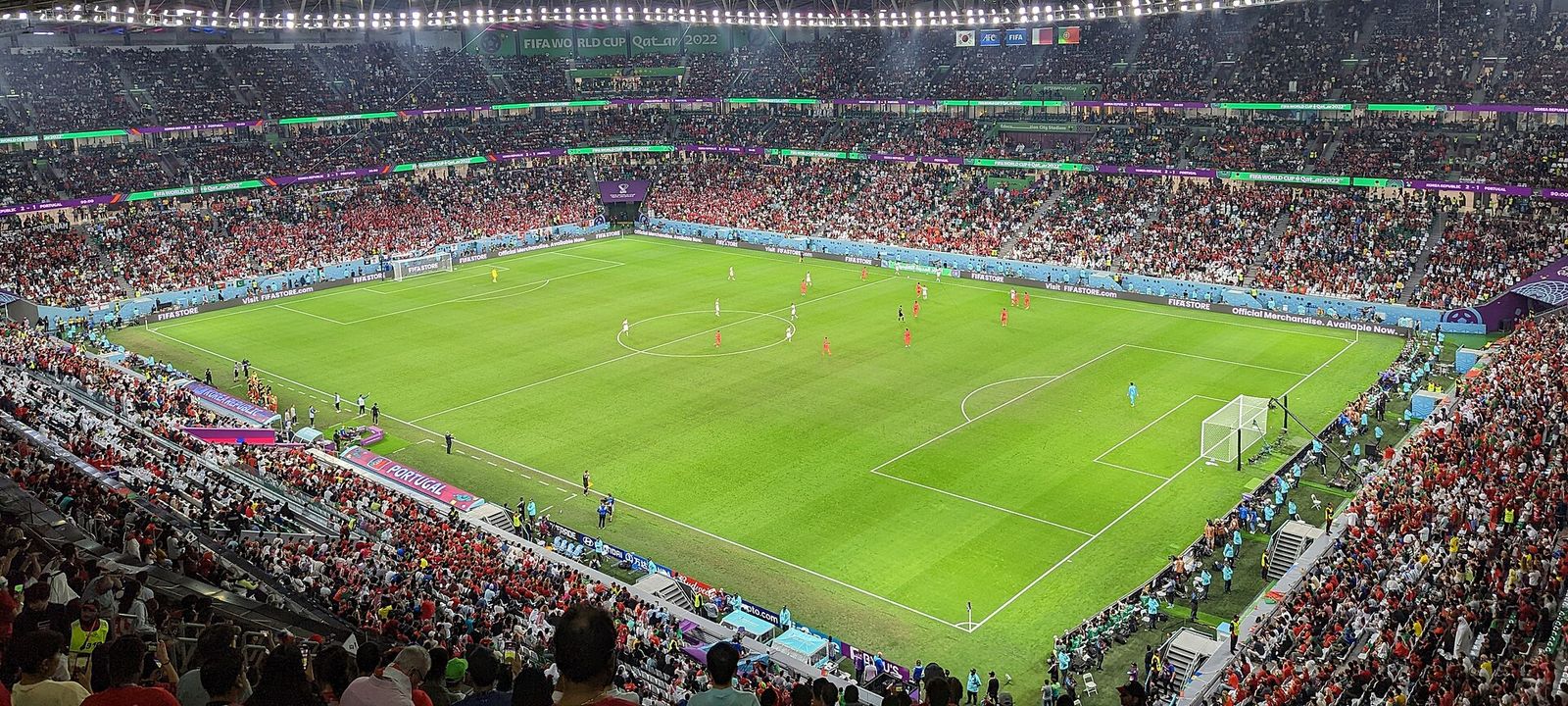
South Korea against Portugal at Education City Stadium, 2 December 2022.
Spec sheet
Figures for the 2022 tournament layout- Area / city
- Education City, Al RayyanAbout 7 km north-west of central Doha
- Opened
- 2020Officially opened on 15 June 2020
- Tournament capacity
- c. 44,7002022 World Cup layout
- Design concept
- Diamond in the DesertCredits vary: Fenwick Iribarren Architects, Pattern Design
- Nearest metro
- Green Education CityThen a walk across the campus
- About the design
- Triangular panels form diamond-like patterns across the facade. They catch the light by day, appear to shift colour as the sun moves across the sky, and are lit by LEDs after dark.
The stadium in brief
Education City Stadium is the one World Cup venue built in the middle of a university campus. It belongs to Qatar Foundation, the non-profit organisation behind Education City, and it was designed with two lives in mind: a tournament stadium of around 44,700 seats for 2022, and afterwards a smaller home for student sport. Construction finished in 2020, it was officially opened on 15 June that year, and its first competitive match, a Qatar Stars League fixture, followed on 3 September 2020.
Its nickname, the Diamond in the Desert, comes from the facade. Seen from the campus roads, the stadium looks less like a sports ground than a cut stone set among lecture halls and research buildings.
Where it is
Education City sprawls across a large site in Al Rayyan, about 7 km north-west of central Doha. Branch campuses of several international universities share it with Hamad Bin Khalifa University, research institutes, schools and some striking public buildings, including Rem Koolhaas's Qatar National Library and the Education City Mosque with its two tall minarets. Khalifa International Stadium and Aspire Zone are a short drive to the south.
The campus is spread out and built for cars and its own internal transport, so distances on foot are longer than they look on a map. Plan your route to the stadium before you arrive rather than improvising from the station.
Design and architecture
The facade is made of triangular panels arranged in diamond-like geometric patterns. Their angles catch the sun differently through the day, so the colour of the skin appears to shift from hour to hour, and after dark it is lit by thousands of LEDs. Design credits vary between sources: Qatar Foundation names Fenwick Iribarren Architects, while other accounts give Pattern Design the lead design role.
Inside, the stadium is built purely for football. With no running track, the stands rise close to the touchline, and the bowl feels compact for a ground of its size. That closeness made for a memorable atmosphere in 2022, never more so than when Morocco's supporters filled it for the round of 16.
Cooling and sustainability
Like the other tournament venues, the stadium uses cooling that delivers chilled air close to spectators and the pitch, so football can be played in comfort for more of the year. The system builds on the approach first proven at Khalifa International Stadium.
Sustainability was part of the brief from the start. In 2019 the stadium received a five-star rating for design and construction under GSAS, the Global Sustainability Assessment System, which Qatar Foundation describes as a world first for a stadium. According to the foundation, most of the building materials were sourced in the region and almost three in ten contained recycled content.
History and big matches
The stadium's debut on the world stage came a little later than planned. It was meant to host the final of the 2019 Club World Cup, but its opening was delayed and those matches moved to Khalifa International Stadium. It made up for it at the next edition, played in February 2021, when Bayern Munich beat Tigres 1–0 here in the final. Five matches of the 2021 Arab Cup followed that December.
During the 2022 World Cup the stadium hosted eight matches, and several of them were among the most dramatic of the tournament. South Korea's late 2–1 win over Portugal sent them through to the knockout rounds. Morocco then knocked out Spain on penalties in front of a record crowd of 44,667, and Croatia beat Brazil on penalties in the quarter-final.
Big tournaments have returned since. Education City staged ten matches of the 2023 Asian Cup in January and February 2024, including a quarter-final, and five more at the 2025 Arab Cup.
Legacy for the campus
The plan published before the tournament was to keep about 25,000 seats for university sport and remove the modular upper sections. Qatar Foundation also announced that two of its schools would operate within the stadium precinct, and that the venue would host women's sport and community programmes. How far each of these plans has progressed varies, so check current information before relying on a particular capacity or facility.
Getting there
Education City station on the Green Line is the stop for the stadium. It is the last stop before the western terminus at Al Riffa, and you can change onto the Green Line at Msheireb in the centre. See Getting Around for how the metro works.
How to get there
-
Take the Green line to Education City
From Msheireb, ride west towards Al Riffa. Education City comes straight after Qatar National Library station.
-
Walk or ride across the campus
Estimates for the walk range from about 10 to 20 minutes, depending on your exit and gate. Education City's own tram has linked the station with parts of the campus, so check whether it is running on the day.
-
Or arrive by Road
Taxis and ride-hailing apps work well on ordinary days. On event days, drop-off points are set by the organisers and can be a long walk from the stadium.
Event-day arrangements change. Check the metro operator's and the venue's current information before you travel.
Around the stadium
Qatar National Library
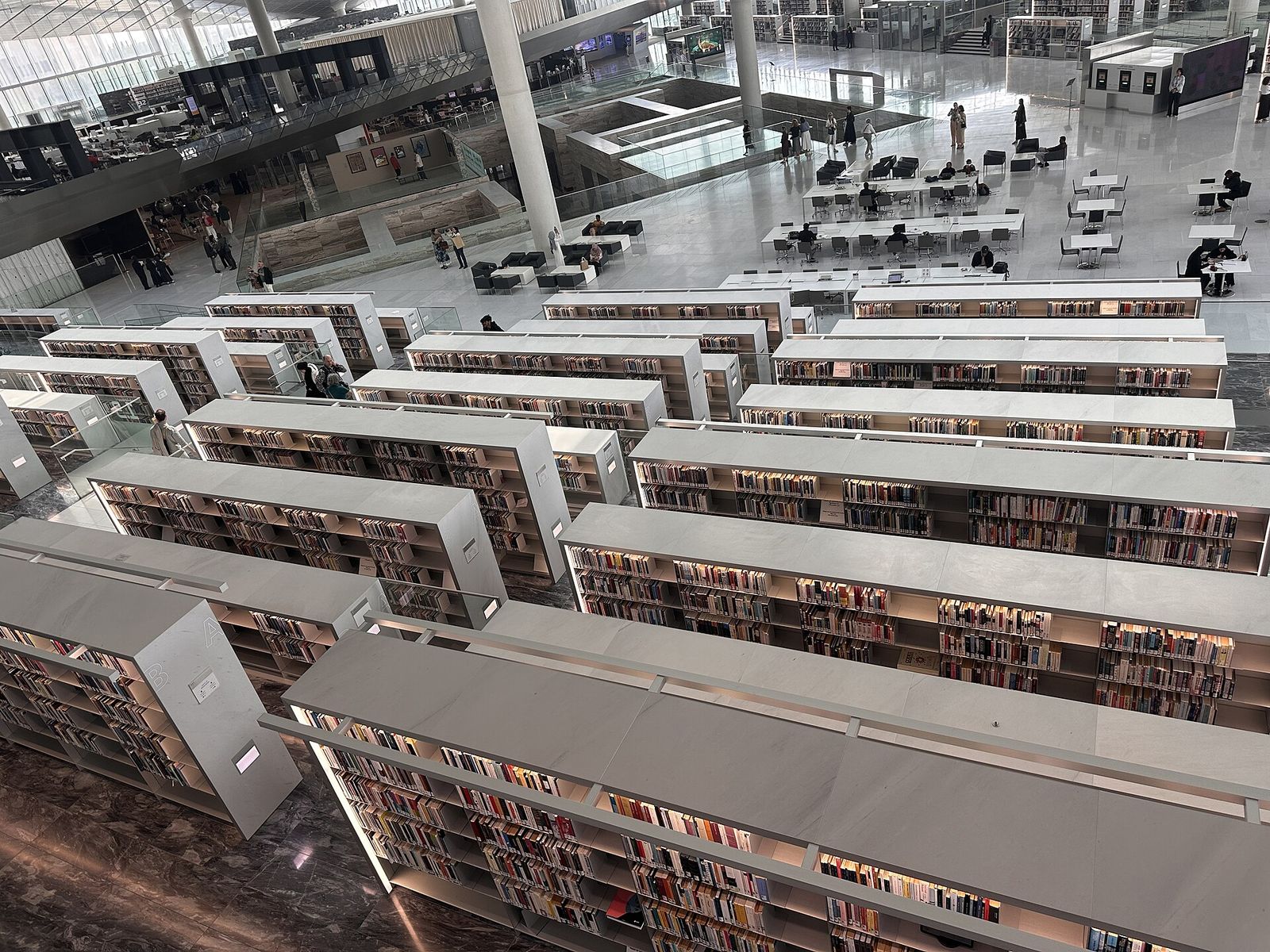
Designed by OMA under Rem Koolhaas, the library is one vast, terraced reading room with its own station on the Green Line. Visitors are generally welcome, but opening hours and entry rules change, so check the library's official information before you go.
Education City Mosque and Oxygen Park
The mosque's two tall minarets are visible from much of the campus, and the landscaped paths of Oxygen Park nearby are popular with walkers and runners in the cooler months.
Aspire Zone
A short drive south, Khalifa International Stadium and the parks and halls of Aspire Zone make an easy pairing on the same day. For museums and districts further afield, see our Sights guide.
Visiting tips
The open spaces between campus buildings offer little shade, so the walk to the stadium matters more than the time inside. From May to September daytime highs reach around 39 to 42 °C; between November and March they sit between about 23 and 30 °C. For big fixtures, aim to reach the station 90 minutes to two hours before kick-off, and expect long, slow queues for the metro afterwards.
What to carry
- A refillable water bottle, if the venue's rules allow it
- A hat and sunscreen for the walk across the campus
- A light layer for the cooled stands and air-conditioned trains
- A charged phone with your digital ticket and route saved
- Comfortable shoes, because campus distances add up
Check before you go
Opening hours, entry rules and timetables change, so check the official venue or operator information before you visit. Our Matchday Guide has more on security, heat and getting home.
Frequently asked questions
Why is it called the Diamond in the Desert?
The facade is covered in triangular panels arranged in diamond-like patterns. As the sun moves they appear to change colour, and at night they are lit from within, which gives the building a gem-like look.
Which metro station serves the stadium?
Education City on the Green Line. From there it is a walk across the campus, or a ride on Education City's own tram when it is running.
Is the stadium only used by students now?
No. University sport was always part of the plan, but the stadium has continued to host international tournaments, including the 2023 Asian Cup and the 2025 Arab Cup.
Is it close to Khalifa International Stadium?
Yes, both are in Al Rayyan, a short drive apart. They are on different metro lines, though: Education City on the Green Line and Khalifa at Sport City on the Gold Line.