Lusail · 2022 World Cup final venue
Lusail Stadium
The golden bowl north of Doha where Argentina and France played the 2022 final. How it was designed, what it has hosted since, and how to reach it by metro.
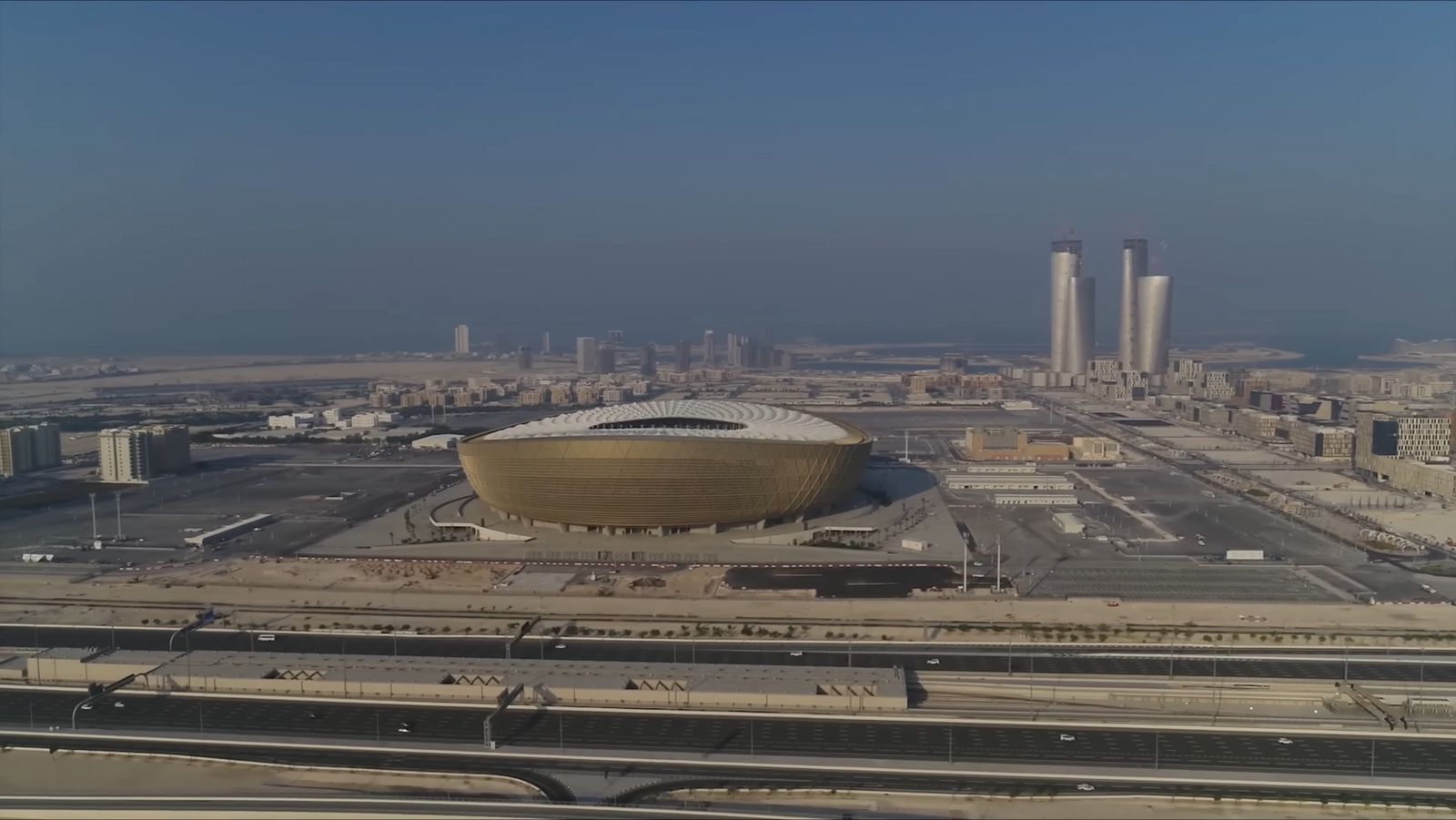
Lusail Stadium from the air, with the towers of Lusail behind it.
Spec sheet
Figures for the 2022 tournament layout- Area / city
- LusailAbout 20 km north of central Doha
- Opened
- 2022First match on 9 September 2022
- Tournament capacity
- c. 89,0002022 World Cup layout (88,966)
- Design concept
- Fanar lantern and Arab vesselsFoster + Partners with Populous
- Nearest metro
- Red LusailRoughly a 10 to 15-minute walk; check event-day access
- Notable matches
- The 2022 final on 18 December 2022, the opening match and final of the 2023 Asian Cup (played in early 2024), the 2024 Intercontinental Cup final and the 2025 Arab Cup final.
Overview
Lusail Stadium is the largest of the eight venues Qatar built or rebuilt for the 2022 World Cup, and the one most people recognise from television: a gold-coloured bowl on a broad plinth at the edge of a city that barely existed twenty years ago. Its tournament layout held about 89,000 spectators, roughly twice as many as most of the other venues. On 18 December 2022, which is also Qatar National Day, it staged the final between Argentina and France.
Since then it has become the country's stage for showpiece occasions rather than a weekly club ground. When a big final is played in Qatar, there is a good chance it is played here. On days without an event, how close you can get to the building varies, but the facade is easy to see from the surrounding streets, and the district around it is one of the more pleasant parts of greater Doha to explore on foot in the cooler months.
Lusail and the setting
Lusail is a planned city on the coast about 20 km north of central Doha, built mostly over the past two decades. Marinas, residential islands, office towers and long landscaped boulevards replace the narrow lanes of old Doha, and the scale takes a moment to get used to: roads are wide, distances between blocks are longer than they look, and shade is not always where you want it.
In the middle of the day the streets can feel almost empty. Things change after sunset, when families come out to the waterfront and the promenades, and change again on match nights, when tens of thousands of fans stream between the metro and the gates. Lusail is also Qatar's sporting north. The motor-racing circuit and a large indoor arena are in the same part of the city, and both are covered on our More Venues page.
Design and architecture
The design concept came from Foster + Partners, with Populous working on the seating bowl. Two references run through it. The first is the fanar, the traditional lantern whose pierced metal throws patterns of light and shadow. The second is the decorated bowls and vessels made across the Arab and Islamic world. From a distance the stadium reads as one burnished golden vessel set on a podium. Up close, the skin turns out to be many flat triangular panels on a steel frame, cut with triangular openings that follow the structural grid.
Those openings do practical work. They shade the concourses and let filtered daylight fall across them, much as a lantern scatters light across a wall. Inside, the architects deliberately compressed the space between the lower and upper tiers, so that you enter between them and only then see the full bowl open up in front of you. Overhead is a spoke-wheel cable-net roof roughly 300 metres across, one of the largest of its kind, covered in a translucent membrane that shades the stands while the centre stays open above the pitch.
A note on the name
During construction the project was usually called Lusail Iconic Stadium. You will still see that name in older articles and maps, but it refers to the same building.
Big matches
The stadium was inaugurated on 9 September 2022 with the Lusail Super Cup, a match between the champions of Saudi Arabia and Egypt watched by about 77,600 people. Ten weeks later it was one of the busiest venues of the World Cup, with ten matches. They included Saudi Arabia's 2–1 group-stage win over Argentina, one of the great shocks of the tournament, and Argentina's 3–0 semi-final win over Croatia.
The final was 3–3 after extra time, and Argentina won 4–2 on penalties. The official attendance was 88,966, the same figure recorded at two of Argentina's earlier matches here. The ground has kept its role since. Qatar retained the Asian Cup on this pitch on 10 February 2024, beating Jordan 3–1, and 18 December has become something of a fixed date for finals here.
Cooling and sustainability
Like six of the other seven stadiums, Lusail uses the cooling approach developed for the tournament by a team under Qatar University engineer Saud Abdul-Ghani. Chilled air comes out of outlets beside the pitch and small diffusers under the seats, and much of it is drawn back, cleaned and cooled again rather than lost to the sky. The roof and the shaded concourses help hold a cooler pocket of air inside the bowl.
Organisers said the cooling was powered by solar energy, and the architects report a five-star rating under the Global Sustainability Assessment System, Qatar's green building scheme. Independent analysts disputed the tournament's wider claims of carbon neutrality, so treat the headline figures with some caution. For a visitor the practical point is simpler: in the cooler months you may barely notice the system at an evening match, but the walk to and from the gates is outdoors and uncooled.
Legacy after 2022
Before the tournament, the plan was to reduce Lusail to around 40,000 seats and turn the freed space into community facilities, with shops, cafés, education and sports facilities and a health clinic mentioned in the published plans. By the end of 2025, according to the reports we could find, the seat reduction had not happened. The stadium instead kept staging finals in front of crowds well above 80,000.
Plans like these can change quickly, so do not rely on any capacity figure for a future event, including ours. The official event information will tell you how the stadium is configured for the match you want to see.
Getting there
Lusail is one of the easiest stadiums to reach without a car, because the Red Line ends almost on its doorstep. See our Getting Around guide for how the metro, tram and feeder buses fit together.
How to get there
-
Take the Red line north to Lusail
Lusail is the northern end of the line, so you cannot overshoot. From central Doha the ride takes around half an hour, depending on where you board.
-
Walk to the stadium
On a normal day the walk takes roughly 10 to 15 minutes. On event days, follow the signed routes and stewards; crowd management can make the route longer than the straight line.
-
Or use the Tram through Lusail
The Lusail Tram connects with the metro at Legtaifiya and Lusail and runs through the district. Some tram services near the stadium have been paused during big events, so check before relying on it.
-
By Road: taxi or ride-hailing
On match days drop-off and pick-up zones are usually set well away from the gates, so expect a walk at both ends.
Event-day arrangements change. Check the metro operator's and the venue's current information before you travel.
Around the stadium
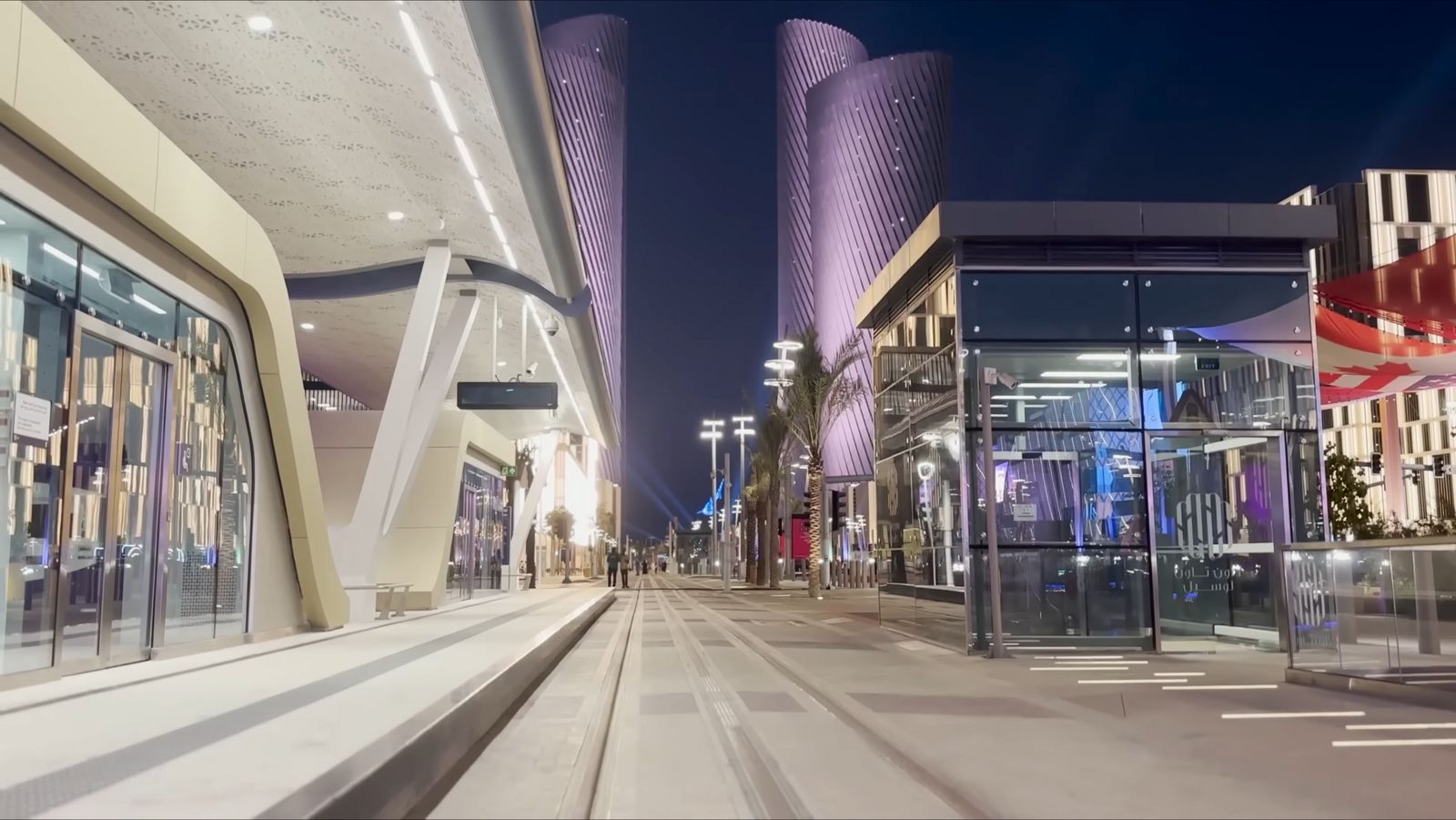
Lusail Boulevard, a long promenade lined with towers, is the obvious place to go before or after a visit. It is at its best after dark, when the buildings are lit and the heat has gone out of the pavement, and it has been used for celebrations and fan gatherings during big tournaments. The marina waterfront nearby is good for an evening walk.
A few stops south on the same Red Line, Katara station serves Katara Cultural Village, with its open-air amphitheatre, galleries and beach. It makes a good second stop on the way back into the city. For the rest of Doha's museums and districts, see our sights guide.
Visiting tips
Plan your visit for the cooler part of the day. From roughly November to March, evenings in Lusail are comfortable. From May to September even a short walk across the open plazas at midday is hard work. For a match, arrive early: security checks and the walk from the station take time, and the metro is at its busiest in the hour after the final whistle. If you are in no hurry, let the first wave of fans go before you head for the platforms. Our Matchday Guide covers the whole day in detail.
- Your match ticket on a charged phone, plus a power bank
- A refillable water bottle, if the venue's bag rules allow it
- Comfortable shoes for the walk from the station
- A light layer for cooled concourses and breezy evenings
- A hat and sunscreen for any daytime event
Before you go
Opening hours, entry rules and timetables change, so check the official venue or operator information before you visit. If you hope to see inside on a non-match day, look for official tours or open days; we cannot confirm a regular public tour programme.
FAQ
Is Lusail Stadium on the metro?
Yes. Take the Red Line to Lusail, its northern terminus, and walk for roughly 10 to 15 minutes. On match days the walking route is usually signed and staffed.
How many seats does Lusail Stadium have today?
It held about 89,000 people in its 2022 layout. A reduction to about 40,000 seats was planned, but by the end of 2025 it had not been carried out according to available reports, and finals since then have drawn crowds above 80,000. Check the event information for the current configuration.
Can I visit without a match ticket?
You can see the facade from the surrounding streets and combine it with an evening on Lusail Boulevard. Access to the stadium precinct and the interior depends on what is happening that day, so check official channels for any tours or open days.
Why is the stadium gold?
The colour and the pierced triangular skin refer to decorated bowls and vessels from across the Arab and Islamic world, and to the way light passes through a fanar lantern.